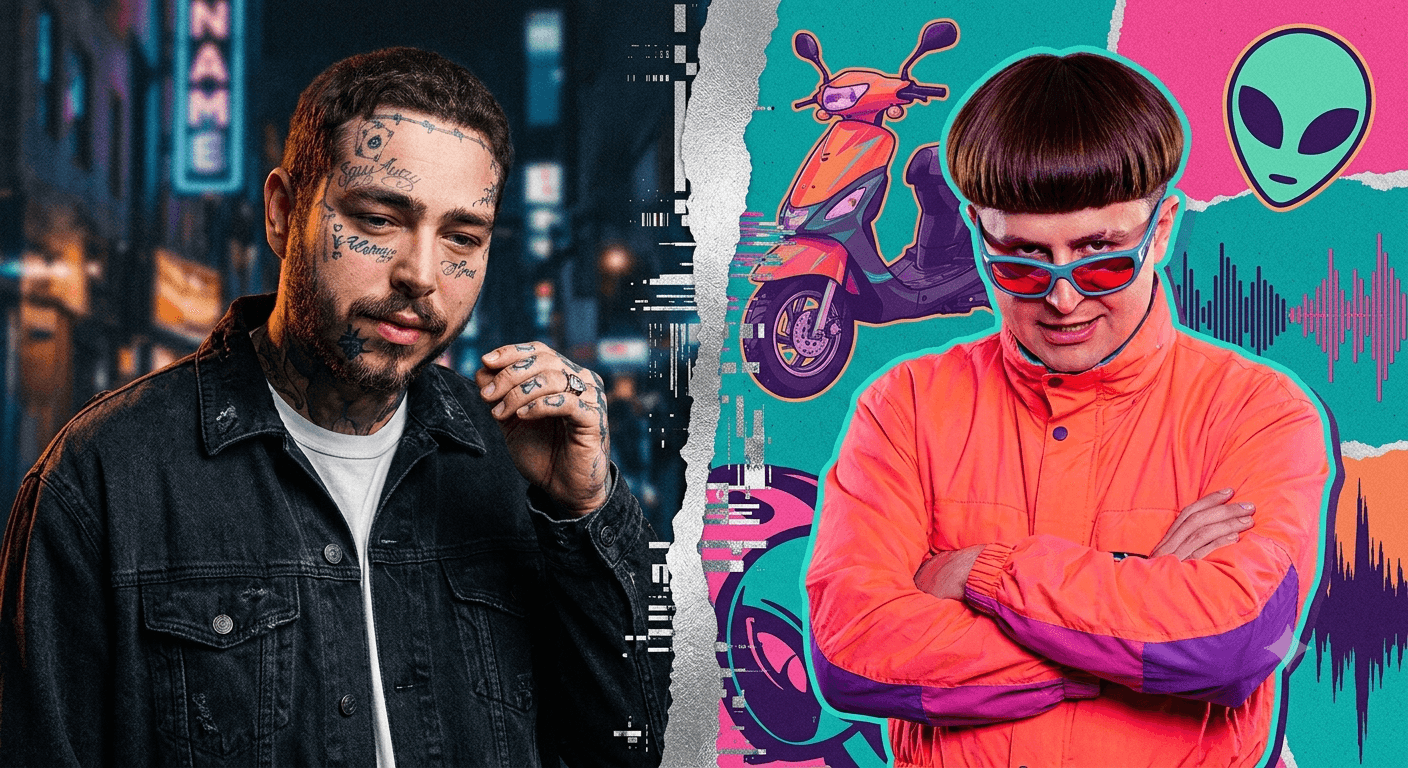
Sonic Rebels and Subversive Stars: How Oliver Tree and Post Malone Redefined the Modern Music Landscape
The music industry has always been a battleground between authenticity and artifice, but the internet era birthed a completely new breed of superstar: the genre-blind, meme-literate multi-hyphenate. Among the most definitive icons of this movement are Post Malone and Oliver Tree. While they carved out vastly different aesthetics—one opting for heavily tattooed, introspective vulnerable trap-pop, and the other leaning into chaotic, bowl-cut-sporting performance art—both artists fundamentally reshaped how the world consumes alternative music.
Following the tragic news of Oliver Tree’s passing at the age of 32 in a helicopter accident in Rio de Janeiro, music fans are looking back at his legacy, highlighting just how profoundly he and contemporaries like Post Malone rewrote the rules of stardom.
Born from the Internet, Built for the Mainstream
Neither Post Malone nor Oliver Tree found success through traditional record label scouting; they conquered the digital frontier first.
- Post Malone exploded out of SoundCloud in 2015 with "White Iverson," a track that seamlessly blended low-key hip-hop dynamics with an undeniable pop sensibility.
- Oliver Tree took a more theatrical route, utilizing early viral platforms like Vine and later TikTok to weaponize internet culture. Clad in oversized JNCO jeans and riding motorized scooters, Tree created a polarizing "Turbo" persona that forced people to stop and look—only for them to realize that beneath the comedic exterior lay a brilliant alt-pop producer.
While Post Malone used the internet as a launchpad to become a mainstream radio juggernaut, Oliver Tree used it as a stage for continuous, avant-garde performance art, treating his entire career as a living, breathing satirical commentary on fame itself.
The Art of Genre-Blurring
If you look at the discographies of both artists, the borders between rock, pop, hip-hop, and electronic music entirely dissolve.
Post Malone shattered genre boundaries by infusing grunge-era vulnerability into modern trap beats. Hits like "Circles" and "Rockstar" proved that an artist could dominate both hip-hop charts and top-40 radio simultaneously. He didn't fit into a box, so the industry had to build a bigger box around him.
Oliver Tree approached genre-blending with a chaotic, hyperactive energy. Tracks like "Alien Boy," "Life Goes On," and his final 2026 record Love You Madly, Hate You Badly are masterclasses in sonic whiplash. Within a single album, Tree could pivot from 90s-inspired skate punk and alternative rock to heavy electronic dance music and synth-pop. If Post Malone's music feels like a late-night, melancholic drive, Oliver Tree’s music was the equivalent of a neon-drenched festival mosh pit.
Real Personas vs. Living Cartoons
The most fascinating divergence between the two lies in how they handled their public images. Post Malone won the world over by being disarmingly sweet and down-to-earth. Despite his intimidating, heavily tattooed exterior, his public persona has always been defined by genuine humility and an earnest love for his fans.
Oliver Tree took the exact opposite approach. He committed so deeply to his obnoxious, demanding, and eccentric alter-egos that fans spent years wondering where the character ended and the real Oliver Nickell began. He staged public feuds, falsely announced his retirement multiple times, and treated interviews as comedic improv sketches. Yet, it was precisely this subversion that made him brilliant; he exposed the absurdity of modern celebrity culture by parodying it to the extreme.
A Legacy of Total Creative Control
The sudden loss of Oliver Tree while traveling on his global tour in Brazil leaves a massive void in alternative music. He was an artist who directed his own wildly complex music videos, wrote his own hooks, and refused to let the corporate music machine dictate his identity.